



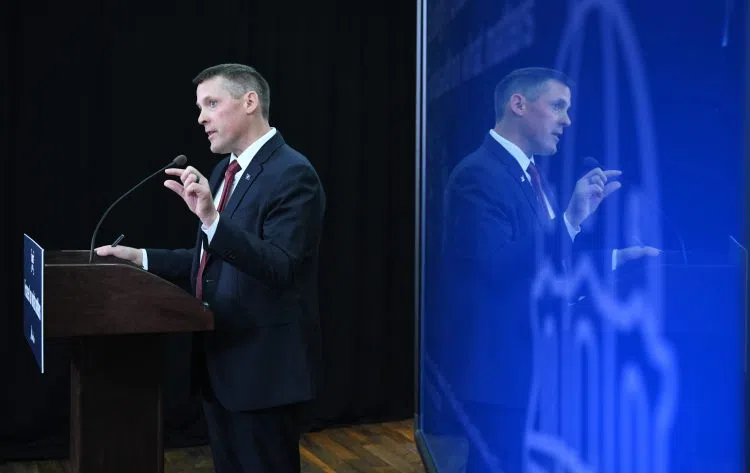
As you have heard the talk about the latest budget by the Province of Alberta there is quite a bit of “red”. The deficit predicted for 2026 is $9.4 billion.
MLA for Drumheller-Stettler and Finance Minister Nate Horner shares that the even though the revenue is less, they continue to invest in key sectors in the province. “We’ve heard repeatedly that we needed to continue to invest in health and education, and we agreed. We didn’t have the capacity to do everything that we wanted to do, but I think when you look at this budget, you see a 7.2% increase in K-12 education and about 6% increase across the board in the health ministries. We definitely tried to put what we thought, what dry powder we had into those places. I would say our overall operational expense, we had to keep to pop(ulation) plus inflation, so it’s substantially lower than that, so every other ministry had to get substantially less.”
For us in Drumheller and essentially our rural area, we see the investment in the larger centres with new schools and new hospitals. Horner understands the difficulties facing investment in the rural areas compared to where the population growth currently is exploding. “It’s very difficult. It was difficult, it’s difficult always, and it was difficult before, but when you see the kind of population growth that we’ve had, it’s very challenging. We’re we’re building schools across the province, but certainly the majority are going into those dense, high growth areas, North Calgary, Airdrie, South Edmonton, where it is the most dramatic. We try to put all those things on the table. This is a big province. We need to continue to build infrastructure everywhere, but we do have to answer the call where the need is the highest. It’s never lost on us, but it’s more difficult in these times of rapid population growth.”
Horner also agrees that investing in healthcare in rural Alberta is a challenge. It is not just because of population but demographics play into the equation. “We’re still the youngest population, but we’re in many ways, getting oldest the quickest in Canada. We’re going to go from one in seven seniors to one in five pretty quickly. We need to make sure that we have those services across the province, but we need to make sure that the hubs, where people do drain to for those higher levels of care, have enough capacity. So you kind of have to look at both things at once, and it’s a challenge. It means you have to invest across the system.”
With all the political instability around the world and even in Canada, Horner still believes that Canada and Alberta are in a stronger position, stability-wise than other areas of the world. “I don’t know if the world’s ever been less stable, but I think that does make Canada and Alberta look more stable globally. That perception’s real. I know the Premier said that. Iran is a great example why countries around the world should be looking to Canada for that stability. That’s why pipelines in all directions and having access to those markets would be the best thing for the country, and for Alberta, to grow our production and answer the call for the globe. When it comes to our budget, this has always been the case for Alberta, that we’ve been on what’s been dubbed the oil and gas roller coaster. For most Albertans, they’re not buried in the books like I am, how it impacts them is they see governments that spend a lot in a surplus and then they’re forced to cut a lot in a deficit due to the price of oil. What we’re trying to do is hold that operational expense steady. We’re really trying to limit and put pressure on how fast we can increase spending, and then when we do end up in a surplus position, we can do the right thing with it. We can invest it in the Heritage Fund or we can pay down debt. In the inverse, it should show the stability that we’re able to weather a deficit cycle when prices are lower. The impact is so great and that’s changed a lot too. I can remember it wasn’t too many years ago, a dollar difference in WTI (West Texas Intermediate oil per barrel) was about $200 million. Now, in the last two years, it’s been between $680 million and $750 million, so the impact is even more dramatic.”
Comments