



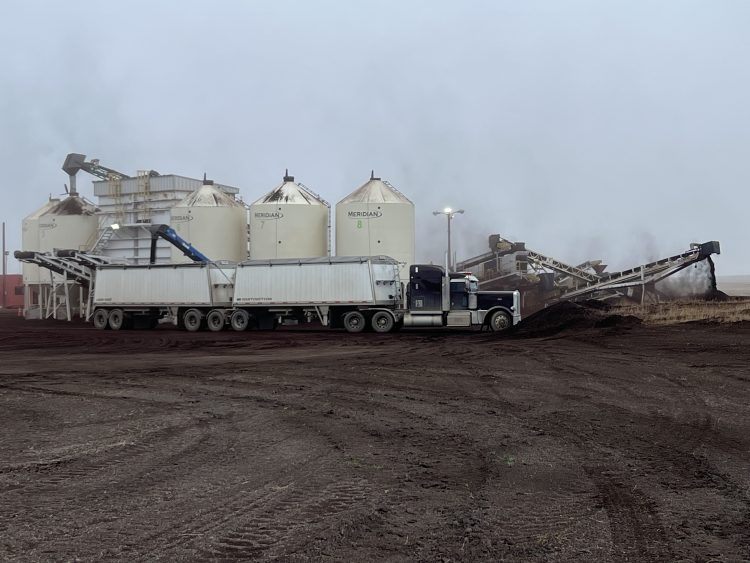
It has been a few years since coal mining has stopped at the Sheerness Mine adjacent to the Sheerness Power Plant south of Hanna.
A product that was found years ago on the grounds of the mine area has continued to see development growth, helping keep people employed at the former coal mine, humic acid, also known as Humalite. Black Earth continues to develop the product which helps soil hold moisture. Clay Williams an engineer with Black Earth, the company mining the Humalite, shares that the product comes from the same area as the coal did but it is a completely different mineral. “Geographically, yes, same area, but it is a total different thing. It’s a different mineral, a different reserve, created a very different geological process. It’s very rich in humic acid, very rich in a lot of these humic substances, whereas coal is not. This is not coal, this is humalite. Ultimately, it’s a product that’s high in these humic substances that can create a lot of benefits within the soil. It does lots of soil building properties, has this high humus content to it that holds moisture, retains nutrients, ultimately builds organic matter within your soil to have a lot of the resilience in your soil that you’re trying to build.”
This product has been mined in the Sheerness area for a number of years and Williams notes that they have seen some great results. “We’ve been doing lots of trialing over the last few years. In 2021, we went into reclaiming the old coal reserves and the disturbance from that. We’ve used a lot of it on the site there in a fairly arid environment and saw lots of the benefits. We’ve built topsoil with it. We’ve seen a lot of the salinity benefits to it. Then just trialing we’ve done in the area as well, seeing lots of benefits in this Palliser triangle type area where there’s more challenging soils, more salinity, where it’s binding up sodium, binding up salinity. It’s helping hold moisture in places. It’s just a long-term builder soil. So especially some of these ones that we’ve had uses on the land two, three, four years, we’re really starting to see some of the benefits on it and see some of the resilience that their soils have in both the nutrient holding side as well as the water retention side.”
Williams shares that the huge benefit from the Humalite is helping the soil hold nutrients. “These humics are very complex carbon structures that have a lot of these different properties to them, so it can hold onto things. That’s why it’s good as a nutrient holding for plants. It’ll grab onto all the nutrients that your plant needs and then give it back to them when the plant needs it. That’s because it’s a really complex carbon structure that can hold onto things at different places within that molecule. What it actually works really well on too is it grabs on to things you don’t want and ties them up like sodium, those type of things within the salt structure. It works really well on solonetzic soils, which you see a lot of in the Pallister Triangle, which is these heavy clays that are glued together with salt. So, if you can use these humics to grab onto that sodium and replace it with something else, you now chemically solve some of these compaction issues that you see in these more challenging areas that very complex, heavy carbon can do a great deal in mitigating.”
For more information on the product and opportunities to purchase, visit their website at www.blackearth.com.
Comments